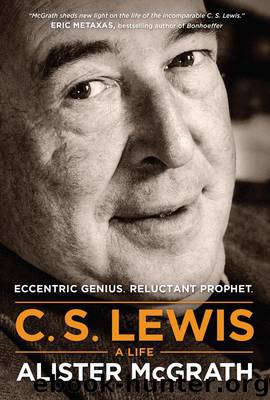
C. S. Lewis: A Life: Eccentric Genius, Reluctant Prophet by Alister E. McGrath
Author:Alister E. McGrath
Language: eng
Format: mobi, epub
Tags: Spirituality, Non-Fiction, Religion, Biography, History
Publisher: Tyndale House Publishers
Published: 2012-03-12T22:00:00+00:00
This analogy enables us to appreciate the essential point that Lewis wished to make: that there is a notional, transdenominational form of Christianity, which is to be cherished and used as the basis of Christian apologetics; yet the business of becoming or being a Christian requires commitment to a specific form of this basic Christianity. “Mere Christianity” might take primacy over individual denominations; yet those denominations are essential to the business of Christian living. Lewis was not advocating “mere Christianity” as the only authentic form of Christianity. His argument was rather that it underlies and nourishes all those forms.
It is this “mere Christianity” that Lewis wished to explain and defend in this work of apologetics. In his 1945 lecture “Christian Apologetics,” Lewis had emphasised that the task of apologists was not to defend the denomination to which they belonged, nor their own specific theological perspective, but the Christian faith itself. Indeed, it is Lewis’s explicit commitment to this form of Christianity that has made him a figure of such universal appeal within the global Christian community.
Lewis presents himself to his readers simply as a “mere Christian,” whom they can adapt to their own denominational agendas and concerns, or can defend and proclaim as a gateway into their own specific “room,” in which there are “fires and chairs and meals.” Lewis is an apologist for Christianity; he would have been appalled to be cited as an apologist for “Anglicanism”—partly because he disliked denominational squabbles, but chiefly because he did not believe in the conceptual extension of the “Church of England” into a global notion of “Anglicanism.”
Lewis’s works—especially Mere Christianity—generally show little inclination to become involved in denominational squabbles about baptism, bishops, or the Bible. For Lewis, such debates must never be allowed to trump or overshadow the big picture—the grand Christian vision of reality, which transcends denominational differences. It is the breadth and depth of his vision of Christianity that achieved such resonance with Catholics and Protestants alike in North America.
There is evidence that Lewis’s interest in this kind of approach developed during the early 1940s. In September 1942, while visiting Newquay in Cornwall, Lewis purchased a copy of W. R. Inge’s study of Protestantism. One phrase in that book—heavily underlined in Lewis’s copy—clearly attracted his attention: “the scaffolding of a simple and genuinely Christian faith.”487 This phrase encapsulates the essence of Lewis’s notion of “mere Christianity.”
Yet Lewis was not alone at this time in wanting to defend a form of Christianity that avoided the fussiness and pedanticism of denominationalism. In 1941, Dorothy L. Sayers—like Lewis, a lay Anglican—set out a similar vision. In the end, this foundered, having become mired in the complexities of denominational politics.488 Lewis, however, succeeded by ignoring them, speaking directly to ordinary Christians over the heads of denominational leaders. And ordinary Christians listened to him, as they listened to no other.
So how did Lewis go about defending this “mere Christianity”? His apologetic strategy in Mere Christianity is complex, perhaps reflecting the fact that four quite distinct sets of talks have been merged into a single book.
Download
C. S. Lewis: A Life: Eccentric Genius, Reluctant Prophet by Alister E. McGrath.epub
This site does not store any files on its server. We only index and link to content provided by other sites. Please contact the content providers to delete copyright contents if any and email us, we'll remove relevant links or contents immediately.
The 5 Love Languages: The Secret to Love That Lasts by Gary Chapman(9761)
The Space Between by Michelle L. Teichman(6913)
Assassin’s Fate by Robin Hobb(6188)
Wiseguy by Nicholas Pileggi(5751)
Everything Happens for a Reason by Kate Bowler(4723)
Gerald's Game by Stephen King(4625)
Pillow Thoughts by Courtney Peppernell(4262)
A Simplified Life by Emily Ley(4145)
The Power of Positive Thinking by Norman Vincent Peale(4045)
Harry Potter and the Prisoner of Azkaban (Book 3) by J. K. Rowling(3338)
Resisting Happiness by Matthew Kelly(3331)
Girl, Wash Your Face by Rachel Hollis(3270)
Being Aware of Being Aware by Rupert Spira(3262)
The Code Book by Simon Singh(3162)
The Secret Power of Speaking God's Word by Joyce Meyer(3144)
More Language of Letting Go: 366 New Daily Meditations by Melody Beattie(3015)
Real Sex by Lauren F. Winner(3000)
Name Book, The: Over 10,000 Names--Their Meanings, Origins, and Spiritual Significance by Astoria Dorothy(2963)
The Holy Spirit by Billy Graham(2932)
